Why Semantic Gatekeeping Hurts Linux Desktop Adoption
The Fastest Way to Make a New Linux User Regret Trying Linux
A new user says, “I’m trying Linux.”
Someone replies: “Linux is just the kernel. You mean GNU/Linux.”
Technically? Sometimes. Historically? Sure. Practically? It’s rarely useful.
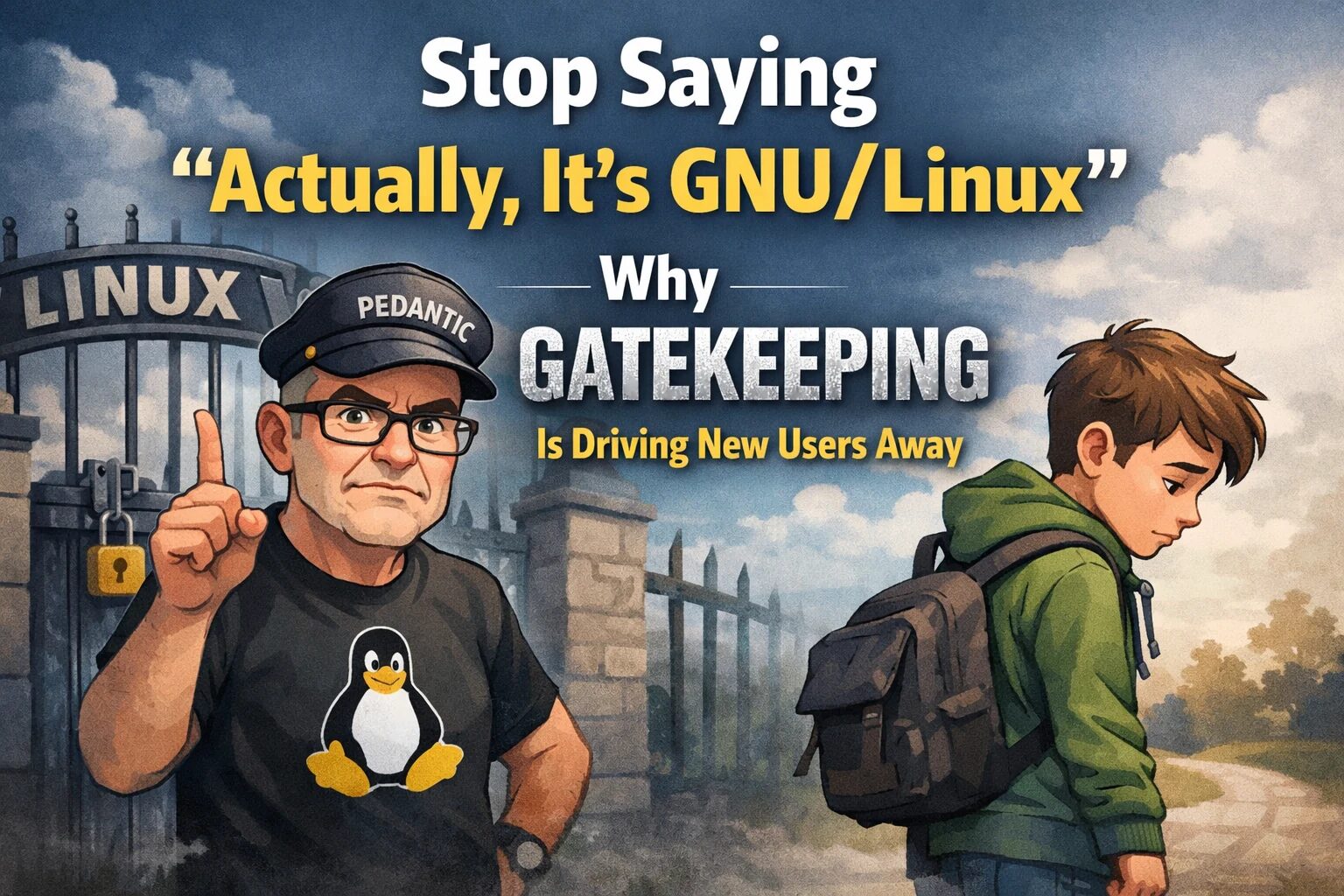
In the real world—where Linux desktop adoption depends on welcoming people into a new workflow—this kind of correction often becomes semantic gatekeeping. It doesn’t teach. It doesn’t solve a problem. It communicates status.
And it drives people away.
The Real Message Behind “Actually…”
When a new user says “Linux,” they are not trying to publish a textbook definition of an operating system. They’re saying:
- “I installed something different.”
- “I’m trying to learn.”
- “I’m stepping out of my comfort zone.”
- “Please don’t make me regret this.”
The “Actually…” response rarely makes their experience smoother. What it does communicate is:
“Before you’re allowed to participate here, you must learn our vocabulary and accept our hierarchy.”
That’s not mentorship. That’s hazing.
Why the “GNU Is the Operating System” Framing Isn’t Factual Anymore
Even if we ignore the social damage, the argument itself doesn’t describe modern computing well.
Linux systems aren’t universally “GNU + Linux”
There are major Linux-based platforms where GNU userland isn’t central—or even present in the way people assume:
- Android runs the Linux kernel with a different userland stack.
- Many embedded systems rely on BusyBox, musl, or custom userlands.
- Minimal container images often look nothing like a classic “GNU system,” despite running on Linux.
So when someone insists “it’s GNU/Linux,” they’re implying a single canonical composition of Linux systems that no longer matches reality.
An operating system is not “GNU or Linux”
This is where the argument collapses: an OS is a stack—kernel + userland + libraries + services + tooling.
GNU provides many userland tools on many distros. Linux provides the kernel. Neither alone is “the operating system” in the way people are using the phrase in day-to-day conversation.
The Practical Truth: “Linux” Names the Ecosystem People Actually Mean
In everyday language, “Linux” typically means:
- a Linux distribution (Ubuntu, Debian, Fedora, etc.)
- a Linux-based operating system
- the broader Linux ecosystem
That shorthand is widely understood and operationally correct for the questions people actually ask:
- “Will this run on Linux?”
- “How do I install drivers on Linux?”
- “Is gaming better on Linux now?”
- “Which distro is good for beginners?”
Correcting someone to “GNU/Linux” usually doesn’t improve the answer. It just changes the vibe—and not in a good way.
Pedantry Isn’t Precision When It’s Used as a Weapon
Let’s be honest: most “Actually it’s GNU/Linux” corrections in casual conversation aren’t about clarity.
They’re about signaling.
They function like a subtle social test:
- “I know more than you.”
- “You’re new here.”
- “Speak our way or you don’t belong.”
That’s not education. That’s gatekeeping.
And you can’t grow a healthy desktop community through gatekeeping.
The Hidden Cost: New Users Don’t Stick Around
Most people trying Linux desktop aren’t looking for ideological debates. They’re trying to:
- get Wi-Fi working
- set up printers
- install apps
- learn a new workflow
- stop fighting with GPU drivers
When their first interaction is a semantic correction, it teaches them one lesson:
“You’ll be punished for being new.”
So they leave—sometimes back to Windows or macOS—not because Linux is impossible, but because the community felt hostile.
If your goal is adoption, that should matter.
When Kernel vs Userland Discussions Actually Make Sense
There are contexts where separating GNU and Linux is genuinely useful:
- OS architecture discussions
- historical context about the GNU Project
- licensing conversations
- engineering explanations of kernel vs userland
- documentation that requires precision
But those contexts are not “a new user trying Linux desktop for the first time.”
If someone is asking how to install Steam, they don’t need a naming lecture. They need help installing Steam.
What Linux Desktop Needs Instead
A better culture is simple:
- Help first
- Teach when asked
- Don’t turn curiosity into a pop quiz
Linux’s obsession with correctness is a strength when it’s applied to code, security, and troubleshooting. It becomes a weakness when it’s used to score points off newcomers.
Linux doesn’t need more gatekeepers.
Linux needs more guides.
Quick Self-Check Before You Comment
Before you hit “Post,” ask:
Does this make Linux more approachable or less?
If it makes Linux less approachable, you’re not defending accuracy—you’re defending ego.
If You Want Linux Desktop Adoption, Act Like It
Linux desktop adoption won’t grow because someone “won” a naming argument in a comment thread.
It grows when new users feel like they can:
- ask questions without ridicule
- learn without being corrected into silence
- explore without being shamed for not knowing the lore
The next time someone says “I’m trying Linux,” resist the urge to flex.
Welcome them. Help them. Keep them.
Because every time we replace “How can I help?” with “Actually…,” we push Linux one step farther from the desktop it deserves.